
How do you measure a bag for airline carry-on size limits?
Airlines limit the outside of the packed bag, and American, United and easyJet all count the wheels and handles. Measuring it yourself, packed and standing, from the floor to the top of the handle, across the widest point and through the fattest pocket, then comparing those numbers with the strictest airline on the trip: that's our pick. You may end up packing tighter than you'd like, since we'd count on a centimetre or two of squeeze from a soft, under-packed bag and none from a hard case.
Outside size, wheels and handles
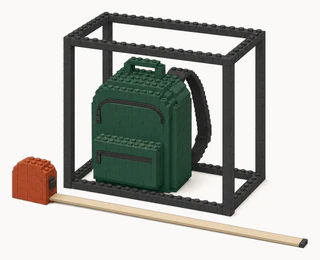
The limit covers the outside of the whole bag. American prints 22 × 14 × 9 in (56 × 36 × 23 cm) "including handles and wheels", United says to "be sure to include the handle and wheels" in its 56 × 35 × 23 cm, and easyJet adds "including any handles and wheels" to both its 45 × 36 × 20 cm and 56 × 45 × 25 cm bags. Wizz Air leaves handles and wheels out of its sizes, but its wheels may add no more than 5 cm. SAS prints 55 × 40 × 23 cm without saying either way. Each of these airline pages was read on 16 Oct 2026; the carry-on limits by airline page covers the rest.
So the tape takes in wheels, feet, every handle and its housing, a stuffed front pocket, and anything clipped outside.
How to measure, step by step
- Pack it the way you'll fly, front pocket included.
- Stand it on a hard floor and push the telescopic handle all the way down.
- For height, lay a book flat across the top and measure from the floor to its underside.
- For width, measure across the widest point, which on a roller can be the wheel housings or a side handle.
- For depth, press two books or boards against the back and the front at the fattest point and measure the gap between them.
- Write the numbers in the unit your airline prints, sort both sets from biggest to smallest and compare each pair, since a soft bag can go into a sizer either way up.
For a feel of the frame, cut a cardboard box to the airline's numbers. If the packed bag only goes in when forced, count it as over.
Worked example: a US-size case on SAS
A traveller on r/HerOneBag asked how to fit an 8-day winter trip to Germany and Prague into SAS's carry-on size. For a case built to the US box, the check runs in four steps:
- SAS prints 55 × 40 × 23 cm and 8 kg on its carry-on page and in its Conditions of Carriage (both read 16 Oct 2026).
- A case built to American's 56 × 36 × 23 cm, wheels and handles included, sorts to 56, 36 and 23, against SAS's 55, 40 and 23.
- That makes it 1 cm too long, with 4 cm to spare on width and nothing to spare on depth.
- SAS's carry-on page and Conditions of Carriage don't say whether wheels count, so measure them in anyway, as American, United and easyJet do.
A hard roller's wheels and handle housing don't flex, so plan to check that case; SAS says a bag that is a bit too big or heavy goes "in the hold, and a fee will apply". A soft backpack listed at 56 cm can still pass if it measures 55 cm or less packed.
Does squishing a soft bag into the sizer work?
A little. Our view is that a frameless bag with some empty space can give a centimetre or two in a sizer. Back panels, frame sheets, wheels and stiff zips don't compress.
A backpack built for easyJet's 45 × 36 × 20 cm under-seat bag is 5 cm over on its longest side and 6 cm over on the next against Ryanair's free 40 × 30 × 20 cm bag, far beyond any squeeze. Ryanair's bag rules say an oversized bag is turned away at the gate or, where available, moved to the hold for a fee (read 16 Oct 2026).
easyJet and SAS both say they check cabin bags before boarding, so pack as if yours will go in the frame. For a fare with only the under-seat bag, see packing with only a personal item.
If your packed bag measures over
First find out why:
| What you see | Likely cause | Fix |
|---|---|---|
| Listed at the limit, but over on your tape | The listing may be for the empty bag, or the expansion zip is open | Zip the expansion shut and repack |
| A roller is over | Wheels or handle housing | Check it in, or carry a soft bag |
| Passes in inches, fails in centimetres | 14 in is 35.56 cm; American prints 36, United 35 | Work in the airline's unit |
| A phone app says it fits | easyJet says its iOS tool "should only be used as a guide" (read 16 Oct 2026) | Use a tape |
If rollers keep failing, backpack vs wheeled carry-on weighs up the switch.
Then try these, in order:
- Empty the front pocket into the main compartment.
- Wear the bulkiest layer and the heaviest shoes on the plane.
- Shift items to the personal item, if it still fits its own limit (under-seat limits by airline).
- Put soft layers in a compression cube to cut the depth; the weight stays the same.
- Pay for the bigger bag online. easyJet charges £60 at the gate (read 16 Oct 2026).
Buying a new bag? Run the same steps before the return window closes, as the guide to choosing a carry-on backpack suggests.
Official sources (read 16 Oct 2026): American Airlines · United · easyJet · Ryanair · Wizz Air · SAS carry-on · SAS Conditions of Carriage
FAQ
Should I measure again before the flight home?
Yes, if anything new is coming back with you. If gifts end up in the front pocket, the spot that decides depth, a bag that passed on the way out can fail on the return. If bottles are part of the haul, the liquids guide covers bringing wine home in a checked bag.