
Does a CPAP or other medical device count as your carry-on?
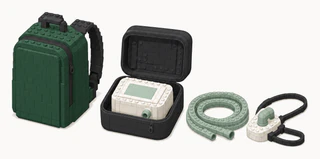
Not on US flights, if the bag holds only the device. The Department of Transportation says "Assistive devices do not count to your baggage limit", but a bag that also holds personal items can be counted and may be charged. Packing the CPAP, hose and mask alone in their own case: that's our pick. Carrying a third piece is the trade-off, and on Lufthansa the device takes the personal-item slot, so you get two pieces in total. The airline has the final say, so ask yours before you fly.
The US rule on device bags, and its one catch
The Department of Transportation's assistive device guide (last updated 4 November 2025, read 17 Oct 2026) puts it in one line: "Assistive devices do not count to your baggage limit." The next line is the catch: "However, if your bag also contains personal items, the airline can count your bag toward a baggage limit and it may be subject to a baggage fee." The federal rule behind it, 14 CFR 382.121, tells airlines that they "must not count assistive devices" toward a carry-on limit, and it names oxygen concentrators, ventilators and respirators among the devices that can come on board.
DOT lists three places the device can ride: "In an overhead compartment; Under the seat in front of you; or In a designated stowage area if the device fits". If it can't go in the cabin, "you do not have to pay a checked-bag fee."
Supplies follow the same logic. Southwest says medications needed for a disability "do not count toward bag limits if they're packed separately from other personal items." British Airways goes further for the hold. Its health page says that on journeys outside the USA, you can check in up to two extra standard bags of essential medical supplies such as dialysis fluid or colostomy bags, and its FAQ adds that each bag can hold only those supplies and that you need a letter from a medical professional.
These are US rules. Outside the US, the airline's own conditions decide, and the BA, Air Canada and Lufthansa rows below show how they differ.
Ten airlines on CPAPs and medical devices
DOT sets the frame for using a CPAP in flight. It says CPAPs "must have a manufacturer's label that indicates the device meets FAA requirements", and that your airline "may require" a passenger to give "a minimum of 48-hours advance notification", to show a medical certificate only "if the airline has reasonable doubt that the passenger can complete the flight safely", to bring batteries for 150% of the flight, and to check in an hour before the regular time. Each airline row below comes from that airline's own page, read on 17 Oct 2026. "Not stated" means the page we read doesn't say.
| Airline | Does the device count toward the cabin allowance? | Before using a CPAP on board | Battery wording |
|---|---|---|---|
| American | "Mobility and medical devices don't count toward carry-on limits"; CPAPs are on the list, but a device may be checked if space is limited | Not stated | Not stated for CPAPs; for oxygen concentrators, "no less than 150%" of flight and ground connection time |
| Delta | Not stated on the customer page | Not stated | "150% of the actual flight time in battery life" to use a PAP on board; not needed if you won't use it |
| United | Free, on top of your carry-on bag allowance, if it fits the overhead bin or under the seat | Medical certificate at least 48 hours before departure; none if you won't use the device | 150% of total flight time, plus connections and time at the airport |
| Southwest | Contract of carriage: may ride in the cabin on top of the carry-on allowance | Not stated | Not stated for CPAPs; for oxygen concentrators, "no less than 150% of the expected maximum flight duration" |
| Alaska | CPAP machines are on its list of items that "may be brought onboard without counting toward your carry-on limit", and "only medication and medical devices may be placed in the bag" | "We no longer require advance notice" to use a PAP machine on board | Not stated for CPAPs; for oxygen concentrators and respiratory or ventilator devices, "no less than 150% of the duration of the flight", plus time on the ground between connections |
| JetBlue | Assistive devices "do not count towards the carry-on limit" | Not stated | Not stated |
| Frontier | Its FAQ says respiratory devices "do not count toward your personal item limit"; its July 2026 special items list says a CPAP "must not exceed allowable carry-on dimensions" | "A medical authorization is not required"; the device needs an FAA approval sticker | "at least 150% of scheduled flight time" |
| British Airways | Cabin: not stated for CPAPs; an oxygen concentrator counts toward the cabin allowance. Hold: a CPAP goes free, outside the allowance | "Medical clearance is not needed" | Recommends "always carrying a dry cell battery" |
| Air Canada | "Always allowed", on top of your carry-on allowance | Not stated | Not stated |
| Lufthansa | Counts as your personal item, next to the usual carry-on of up to 8 kg, so "2 pieces" at most | Register in advance with the Medical Operation Centre | Battery only; on-board power "cannot be guaranteed" |
Delta's agency site for travel agents says assistive devices "are not counted as any part of the customer's carry-on baggage allotment", but its customer page doesn't repeat that line. Only three of the airline pages print a date, namely Southwest's contract of carriage (58th revision, effective 24 Sep 2026), Frontier's oxygen FAQ (last modified 20 Feb 2026) and British Airways' medical supplies FAQ (last updated 24 April 2024). Frontier's special items PDF carries July 2026 in its file title. For cabin bag sizes on these airlines, see the airline cabin bag table.
At TSA security
TSA's CPAP answer reads: "A nebulizer, CPAP, BiPAP and APAP must be removed from its carrying case and undergo X-ray screening. Facemasks and tubing may remain in the case. You may provide a clear plastic bag to place the device through the X-ray." So pack the case with the machine on top, where it comes out without unpacking the hose. Liquid medicine, the TSA Notification Card and pumps you wear are covered on the carry-on medication page.
Portable oxygen concentrators
DOT says airlines "must allow you to bring your POC onboard the aircraft as long as it meets FAA requirements." The FAA's acceptance page (last updated 5 February 2021) says a concentrator used on board must carry a label in red lettering: "The manufacturer of this POC has determined this device conforms to all applicable FAA acceptance criteria for POC carriage and use on board aircraft." Models named in the FAA regulation can fly without the label.
DOT also lists what an airline can ask of you: up to 48 hours' advance notice, a medical certificate, batteries for "no less than 150% of the duration of the flight", and check-in an hour before the regular check-in time. Delta asks for its review "at least 48 hours prior to departure for domestic travel, and 72 hours prior for international". American says the concentrator must fit under the seat in front of you for taxi, takeoff and landing, and you can't sit in an exit or bulkhead row with one.
Spare batteries for a CPAP or concentrator
The FAA caps each rechargeable lithium battery at 100 watt hours (Wh). With airline approval, you can carry up to two spare larger batteries of 101 to 160 Wh each, and that two-spare limit is per person. Spares go in the cabin only, with the terminals covered (FAA PackSafe, last updated 11 August 2026). IATA's passenger guidance, an undated PDF, gives the same cap for medical devices: batteries rated above 100 Wh, up to 160 Wh, need the airline's approval, with a "max 2 spare batteries". The watt-hour arithmetic and power bank rules are on the electronics and power banks page. For powered wheelchairs, DOT's assistive device guide covers battery removal and packing.
Worked example: a backpack, a sling and a CPAP case on United, then Lufthansa
The kit is our own assumption: a carry-on backpack, a sling as the personal item, and a CPAP case with only the machine, hose and mask inside. The trip is a United flight, then a Lufthansa flight.
- On United, the CPAP case rides free on top of the carry-on allowance, so all three pieces come on board.
- To use the CPAP in flight on United, the medical certificate goes in at least 48 hours before departure. United asks for battery power for 150% of the total flight time, plus connections and time at the airport. In United's own example, a 3-hour flight with 2 hours at the airport comes to 6.5 hours.
- On Lufthansa, the CPAP is your personal item, with "2 pieces of hand baggage maximum". The sling goes inside the backpack, or its passport and phone go in a jacket pocket.
- To use the CPAP on the Lufthansa flight, register it first with the Medical Operation Centre, and bring a battery, since the device "can only be battery operated".
If the backpack is already full, a sling that packs flat matters more than the bag's size. On an all-US trip, the sling can stay a separate bag.
Canes, walkers and folding wheelchairs
DOT's guide says: "If you have a wheelchair or walker, you do not need to check them until you are at the gate." A collapsible wheelchair goes in the overhead bin, under a seat or in the wheelchair space "if the device fits", and "Airlines are required to accept for transport at least one manual wheelchair in aircraft with 100 or more seats." American lists canes and walkers that fold to fit overhead or under the seat among the devices that don't count toward carry-on limits.
The same DOT page notes a pause in enforcing its newer rule on airline liability for damaged wheelchairs, so check it again before a trip.
Our pick: the device alone in its own bag
Keep the CPAP case for the CPAP. DOT's line about a bag that "also contains personal items" is the reason: a spare shirt in the case gives the gate agent grounds to count it. Spare filters, the hose and a charging cable belong with the device. A trip list from three weeks in Asia on r/onebag kept a separate CPAP section: a ResMed AirMini, a DIY USB-C charging adapter, a short hose, a hose adapter and filters.
Size helps. A wheelchair user's report of three weeks in Italy on r/HerOneBag says the poster compacted a ResMed AirMini "down to the equivalent of a beer can and a hardback book in volume". When flying, the poster uses the extra allowance for medical equipment to split their luggage into a second bag. For an airline outside the table, ask it directly. A poster on r/emirates, booked in Premium Economy with a wheeled carry-on, asked whether Emirates would allow the CPAP in a separate bag; we didn't read Emirates' page for this one.
Official sources (read 17 Oct 2026): DOT assistive device stowage · 14 CFR 382.121 · TSA CPAP FAQ · FAA portable oxygen concentrators · FAA PackSafe lithium batteries · IATA passengers travelling with lithium batteries (PDF) · Southwest medication · Southwest oxygen concentrators · Frontier special services · Alaska oxygen and respiratory devices · British Airways medical supplies FAQ · Delta agency assistive devices
FAQ
Can I plug my CPAP into the seat power on the plane?
Don't count on it. British Airways says its in-seat power gives at most 75 watts, needs a DC adapter and is only there where installed. United says it "can't guarantee you a seat with in-seat power", and Frontier says aircraft outlets "are not available for use with any electronic device".
Can I use a nebulizer during the flight?
On British Airways, a battery-operated nebuliser can be used on board "except during taxi, take-off, descent and landing". The US airline pages we read don't give a nebulizer rule of their own, so ask the airline before the trip.
What if my ticket is a codeshare?
Ask the airline that operates the flight. American says to "contact the operating carrier", United says to contact a partner airline "directly to confirm their POC policy", and British Airways says to check the operating airline's "own criteria".