
Flying to a trek: carry on, check or buy there
The FAA and IATA bar stove gas from cabin and hold alike, so buy it in Puerto Natales or El Chaltén. Knives, tent stakes and ice axes ride in the hold, and IATA keeps spare headlamp batteries in the cabin. Wear broken-in boots, carry on what's hard to replace, check the sharp kit and rent the bulky down in Kathmandu or Namche: that's our pick. The trade-off is a checked bag to wait for, and on Tara Air's Lukla flight, 10 kg checked plus 5 kg in the cabin.
This guide covers four trips: Kathmandu and Lukla for Everest, Cusco for the Inca Trail, Moshi or Arusha for Kilimanjaro, and Puerto Natales or El Chaltén for Patagonia. Each starts with a long flight under the dangerous-goods table that IATA publishes for airlines, and the Everest trip adds a short hop on a small plane with its own weight limit. Rows marked US apply at American checkpoints, where every TSA item page says the officer has the final decision.
Power banks get one row here. The electronics guide has the watt-hour limits, the per-person counts and the airlines that ban using a bank in flight. Layering for cold lodge nights sits in the cold-weather guide, and boot choice, along with New Zealand's NZ$400 instant fine for undeclared dirty boots, in the shoes guide.
Twelve trek items under three rulebooks
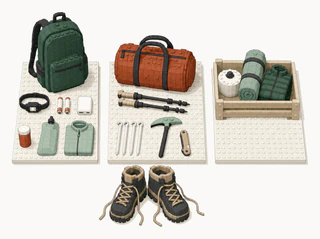
Every source in this table was read on 8 Oct 2026. The trek-country column quotes airlines, an airport and parks in the trek countries: Tara Air and Nepal Airlines in Nepal, Lima Airport in Peru, the Tanzanian airline Flightlink, and the park rules at Machu Picchu and Los Glaciares. The IATA column is the 67th edition of its Dangerous Goods Regulations, dated 1 January 2026, and IATA publishes a new edition every year (IATA DGR), so check the table again for flights from 1 January 2027.
| Item | US flights (TSA, FAA) | International flights (IATA DGR 67) | Trek-country airline, airport or park | Our call |
|---|---|---|---|---|
| Trekking poles | Blunt tips: either bag, though TSA says to check with the airline; "Sharp-tipped hiking poles are not allowed carry-on items" (TSA) | Not a dangerous good; airport security decides | Lima Airport passes walking sticks (bastones) shown to the officer (Lima Airport list, August 2026); Machu Picchu bars them inside the citadel (rules of conduct) | Checked bag, or rent at the trailhead town |
| Ice axe and crampons | Ice axe checked only, sheathed; crampons "Yes (Special Instructions)" for the cabin (TSA ice axes, TSA crampons) | Not a dangerous good | Lima bans ice picks (picahielos) and axes from the cabin; Los Glaciares makes poles and crampons compulsory from May to September (APN) | Checked bag, points covered |
| Tent stakes | Checked only: "Tent stakes must be packed in checked bags" (TSA) | Not a dangerous good | Lima bans awls (punzones) from the cabin; stakes aren't named | Checked bag |
| Knives and multitools | Knives checked only; a multitool with a blade of any length is checked, one with scissors under 4 inches passes (TSA knives, TSA multi-tools) | Not a dangerous good | Lima allows tools and scissors with blades of 6 cm or less; Tara Air takes knives "as Checked Baggage, at our discretion" and never in the cabin (Tara Air terms) | Checked bag, or a bladeless tool in the cabin |
| Stove burner | Either bag if empty and cleaned of all fuel vapour (TSA); the FAA warns that some airlines refuse used stoves however well purged (FAA) | Liquid-fuel stoves: checked only, emptied, with the airline's approval (Table 2.3.A) | Lima passes a new stove with no fuel or gas cylinder; Flightlink takes an empty one in checked baggage at most, with approval at check-in (Flightlink) | A clean canister burner in the checked bag, or none on a catered trek |
| Gas canisters and stove fuel | "All forms of camp stove fuels are forbidden in carry-on and checked baggage" (FAA); butane No and No (TSA) | Absent from the passenger table, so forbidden in both | Flightlink names the "camping gas cylinder" as not accepted; Summit Air bars compressed gases without its consent (Summit Air) | Buy it in the trailhead town |
| Lighters | One lighter in the carry-on or on you; torch lighters forbidden (FAA, TSA) | One small lighter, on your person only; refills forbidden | Lima allows one disposable or Zippo lighter, carried on you | One in a pocket, or buy one there |
| Bear spray | No and No (TSA) | Pepper spray and other "disabling devices" forbidden on you and in both bags | Lima bans animal-repellent aerosols; Flightlink refuses pepper spray | Leave it at home |
| Power banks | Cabin only (TSA) | Cabin only, 100 Wh or less without approval | Nepal Airlines bans using a power bank or spare battery on board (Nepal Airlines) | Personal item |
| Water filter | No TSA entry; an empty bottle is Yes in both bags (TSA) | Not listed; a squeeze filter has no battery or fuel | No rule found | Cabin, on Sawyer's advice (Sawyer) |
| Headlamp batteries | Alkaline and NiMH AA or AAA in either bag, terminals protected (TSA, FAA); spare lithium cells cabin only (TSA lithium) | Spares, dry cells included, "must be carried in carry-on baggage only", 20 at most | Nepal Airlines repeats the IATA line | Spares in the cabin, taped |
| Sleeping bag and boots | Sleeping bag in either bag (TSA) | Not dangerous goods | On Tara Air both count toward 10 kg checked and 5 kg hand carry unless worn or rented | Wear the boots; rent or check the bag |
Two rows split the US from the rest: poles with crampons, and headlamp batteries. TSA lets crampons and blunt poles into the cabin, while Lima Airport keeps ice picks out of the cabin and passes walking sticks only once they have been shown to the security officer. US screening isn't predictable either. On r/hiking, Expensive_Profit_106 called carrying poles on "a gamble" that "could be the last time you ever see those poles", and Jasper2006 described five or six cabin trips before "one time TSA said "NO!"" and a gate agent taped and checked the pair.
Headlamp batteries are the row where the flight home from Kathmandu is stricter than the flight out of the US. The TSA allows alkaline AA and AAA cells in a checked bag, though spare lithium AA and AAA cells are cabin-only there too. IATA's table keeps every spare battery, dry cells included, in carry-on baggage, and Nepal Airlines prints the same line. Pack to the stricter rule for the whole trip and tape the terminals.
Neither the FAA nor IATA makes an exception for gas. The FAA's fuels page covers "compressed fuel canisters, liquid fuels, and solid fuel tabs". IATA's table opens by saying dangerous goods "must not be carried" except as it lists, and gas cartridges for stoves aren't on that list. The only canister at camp is one bought in the trailhead town. A used fuel bottle is a closer call: IATA permits an emptied one as checked baggage, and only with the airline's approval, and the FAA notes airlines that turn down used camping equipment "regardless of how well it has been purged".
The Lukla flight's 15 kg, and who publishes it
Tara Air prints its limit in its terms: "Free baggage allowance limit (10 kg baggage + 05 kg hand carry)", 7 kg for a child, and "Excess baggage fees apply" beyond it. Its FAQ repeats the 10 kg checked and 5 kg of hand luggage and lists Kathmandu, Ramechhap and Lukla among its destinations. The 15 kg is official, then, but it's the airline's figure. Tara Air's terms also say to keep "computers, personal electronic devices" and money out of checked baggage.
We didn't find a baggage figure from the regulator. The Civil Aviation Authority of Nepal (CAAN) posts dangerous-goods regulations and manuals for airlines and handlers, and its 2073 BS air-fare directive (CAAN library) sets rules for fares, cancellations and charters with no baggage weight. Its flight-safety site returned errors on 8 Oct 2026. Summit Air and Sita Air also fly to Lukla (Republica), and neither prints a number. Summit Air's policies page bars compressed gas and lighter fuel without its consent and doesn't give a free allowance, and Sita Air's terms mention weight limits without a figure. If the ticket is on one of them, the number to plan around is the one printed on that ticket.
Worked example: Kathmandu, then Lukla
Take a spring trek to Everest Base Camp: an international flight into Kathmandu, then Tara Air to Lukla. In the busy seasons that hop can leave from Manthali in Ramechhap district instead, a drive from Kathmandu: Republica reported Tara Air, Summit Air and Sita Air starting spring flights from there on 24 March 2024, because Kathmandu's airport is busy in the tourist season. Check which airport the ticket names. Everything that goes up the hill fits 10 kg in the hold and 5 kg in the cabin, 15 kg in total, and anything left over waits in Kathmandu.
| Where it rides | What goes there | Why |
|---|---|---|
| Worn on both flights | Broken-in boots, trekking trousers, a base layer and a fleece | Boots are the hardest item to replace if a bag goes missing |
| Cabin bag, 5 kg on Tara Air | Medication, passport, phone, power bank, headlamp with taped spare batteries, the water filter, rain shell, hat and gloves | IATA keeps the batteries here; Tara Air wants electronics out of the hold; the rest is day one |
| Checked duffel, 10 kg on Tara Air | Spare clothes, toiletries, a sleeping bag liner, a knife or multitool, and poles if they're your own | Sharp items are checked only under TSA rules and Tara Air's terms |
| Rented in Thamel or Namche | Down jacket and sleeping bag, plus poles if none came from home | Both are bulky, and the rental shops are in Kathmandu and on the trail |
Where you rent the sleeping bag changes the arithmetic. Rented in Thamel, it flies to Lukla inside the 10 kg. Rented in Namche Bazaar, it never touches the scale. On r/everestbasecamphike, readsid suggested "Rather then buying, I would suggest renting it in Namche bazzar", and the original poster saw the point: "That ways it doesn't get counted in your weight allocation when flying to Lukla." The catch came from SamDurak060522: "My rented sleeping bag had a smell." For this trip we'd take the Thamel jacket and the Namche bag, with a liner from home in the duffel.
No stove or canister enters the plan. On r/Nepal, the trip-planning account bikal_TripPlanner called EBC "a teahouse trek", and in the sleeping-bag thread above, tRAVel-dot-wIthravi wrote that even as high as Lobuche, for a price, the teahouses offer showers, heated beds and a choice of food.
If the checked bag doesn't arrive
A lost bag on the way to a climb is a real failure mode. On r/kilimanjaro, 00rvr wrote "Someone in my group had to rent and buy everything because her airline lost her luggage". The fix is to fly in carrying what's hardest to replace and what day one needs. Tanzania National Parks lists the core of it in its Kilimanjaro visitor guide: "Carry proper cold-weather and rain gear, headlamp, and personal meds."
Boots come first. In another r/kilimanjaro thread, SiddharthaVicious1 explained that "your boots are the hardest thing to rent or replace because you have already broken them in." An operator in the same thread, AltezzaTravel, advised the opposite: "I recommend keeping your boots/clothes in your checked luggage." We'd still wear them. Even a commenter who rented almost everything brought boots from home: on the r/kilimanjaro rental thread, northern_peony listed the rentals but said "I would definitely bring your own boots and base layers."
Then the cabin bag. Medication goes there, and the medication guide covers prescriptions and liquid medicine. So do documents, the power bank and spare batteries that have to ride there anyway, the rain shell and one warm layer. The water filter joins them because Sawyer tells its own customers to fly with it in the carry-on "so it stays protected from compromising conditions below the cabin." The rule of thumb from ClimbKiliTeam, a Kilimanjaro climbing account, is the test for anything else: "packing what can get you started on day one of the mountain". Poles, stakes, a knife and spare clothes stay in the hold. Poles are for rent at all four hubs below, and the rest matters less on day one. The printable checklist has a cabin-bag group for ticking these off the night before.
Buying or renting at the trailhead towns
In Kathmandu, Thamel is where the rental shops cluster. bikal_TripPlanner on r/Nepal listed what to rent rather than buy: "down jacket and sleeping bag, both bulky and expensive and youll likely never use them again", along with a porter's duffel and trekking poles, and added "thamel has loads of rental shops". The same comment asks you to check the bag's rating ("you want comfort around -10 to -15, gorak shep nights are cold even in spring") and to keep the passport itself back from the deposit: "dont hand over your actual passport".
Kilimanjaro works differently, because nobody climbs alone. Tanzania National Parks states "All climbs must be guided by a licensed operator; solo trekking is not permitted", the tented camps are run by licensed operators, and open fires are restricted, so stove and gas belong to the crew. Rental runs through the operator or local shops. AltezzaTravel, an operator, warned on r/kilimanjaro that local shops stock used gear from guides and porters, and suggested asking your operator for photos and model names before you pay.
The Inca Trail runs through agencies too. Peru's culture ministry resolution RM 333-2026-MC has registered Cusco agencies buying trail tickets for their clients through its TuBoleto platform, and the trip price can include the kit. A March 2026 trip report on r/Machupicchu listed "hire of all equipment (sleeping bag, the sleeping liner and walking sticks)" in the price and said "Make sure you get walking sticks". Hired poles stop at the citadel gate, because Machu Picchu's rules bar walking sticks (bastones) and bags over 40 × 35 × 20 cm.
Patagonia is where you cook for yourself, and where gas is easiest to find. On r/Patagonia, SteelCurtain1933 wrote "These gas cartridges are pretty common in PN as there are a lot international tourists", and for the W trek Apprehensive_Arm1881 promised "There will be plenty of leftovers at each campsite kitchen, plenty!" In El Chaltén, a January 2026 reply on r/ElChalten found isobutane at a second outdoor shop after the first had none: "They had a large bin full of them." Park rules limit where the stove burns. Torres del Paine's regulation allows fire only through portable stoves at expressly authorised sites. Argentina's park service allows only gas stoves at designated campsites in the northern zone of Los Glaciares and warns that the trails have no supplies. Gear rental exists in El Chaltén too ("You can rent gear easily in El Chaltén and prices are very reasonable", flying-pineapple27 wrote on r/backpacking), though that report dates from 2023.
FAQ
Will Tanzania take plastic bags off me at the airport?
Plastic carrier bags, yes. Tanzania banned them from 1 June 2019, and the Vice President's Office notice to travellers says "Special desk will be designated at all entry points for surrender" of plastic carrier bags. Zip-lock bags "specifically used to carry toiletries" are allowed, so the clear bag from the liquids guide passes. Pack the duffel with stuff sacks or a dry bag instead of shopping bags.