What to pack for South Korea in one carry-on (October to February)
Seoul's 1991–2020 normals fall from a 20.2 °C October high to a −5.5 °C January low, and December to February is dry, with 67.6 mm of rain across the three months. Our pick: one cabin bag plus a personal item with a week of clothes, an insulated jacket worn on the plane, a fleece mid layer, closed walking shoes, and a C/F plug adapter if you come from the US, UK or Japan.
Oct to Feb in Seoul: one bag across a 25-degree swing
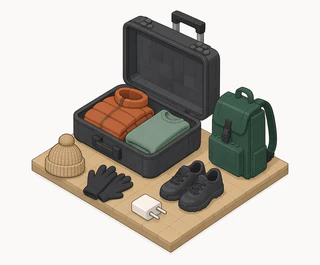
Between an average October afternoon (20.2 °C) and an average January night (−5.5 °C), Seoul's normals cover about 25.7 degrees. A trip in this window is really three trips, and the bag changes with each.
October. Highs of 20.2 °C and lows of 10.6 °C. Light tops, long trousers and one sweater cover it; the coat can stay at home. A trip report on r/HerOneBag from 2 to 25 October put daytime temperatures at "27 C at the start of the trip to 15 C at the end", which is the slide the normals predict.
November. Highs drop to 11.9 °C and lows to 3.5 °C. This is the month the warm jacket joins the list. With 51.1 mm of rain, close to October's 52.2 mm, a compact umbrella still earns a pocket.
December to February. Daytime highs stay at 5.1 °C or below, and nights average below freezing in all three months. An insulated jacket, a hat and gloves are the core, and the rain mostly stops: the three months add up to 67.6 mm, so the umbrella becomes optional.
How to build those layers, and which ones to wear on the plane, is the job of the cold-weather packing guide. This page keeps to what is different about Korea.
12-month Seoul climate table
Thirty-year averages, so a given week can run warmer or colder. Outside October to February, the summer rows explain why this guide stops there: July brings 414.4 mm of rain.
| Month | Mean daily max | Mean daily min | Mean | Precipitation |
|---|---|---|---|---|
| Jan | 2.1 °C | −5.5 °C | −1.9 °C | 16.8 mm |
| Feb | 5.1 °C | −3.2 °C | 0.7 °C | 28.2 mm |
| Mar | 11.0 °C | 1.9 °C | 6.1 °C | 36.9 mm |
| Apr | 17.9 °C | 8.0 °C | 12.6 °C | 72.9 mm |
| May | 23.6 °C | 13.5 °C | 18.2 °C | 103.6 mm |
| Jun | 27.6 °C | 18.7 °C | 22.7 °C | 129.5 mm |
| Jul | 29.0 °C | 22.3 °C | 25.3 °C | 414.4 mm |
| Aug | 30.0 °C | 22.9 °C | 26.1 °C | 348.2 mm |
| Sep | 26.2 °C | 17.7 °C | 21.6 °C | 141.5 mm |
| Oct | 20.2 °C | 10.6 °C | 15.0 °C | 52.2 mm |
| Nov | 11.9 °C | 3.5 °C | 7.5 °C | 51.1 mm |
| Dec | 4.2 °C | −3.4 °C | 0.2 °C | 22.6 mm |
| Year | 17.4 °C | 8.9 °C | 12.8 °C | 1417.9 mm |
Figures from annex 1 of the KMA press release of 25 March 2021 on the new 1991–2020 normals (read 2 Nov 2026). Seoul is the only station in this table.
Heated indoors (ondol): pack layers you can take off
Korean homes and many guesthouses heat through the floor, a system called ondol. For the bag, that means the cold is outside and the warmth is inside, often within the same hour as you move between streets, subway, cafés and museums.
So pack thin layers that come off quickly instead of one thick jumper that stays on. A base layer plus a zip fleece works better than a chunky knit under the coat, because the fleece can go in the daypack the moment a room warms up. Sleepwear can be light, and slip-on socks help on heated floors where shoes come off at the door.
Medicines into Korea
The Korean consulate in Atlanta sets out the rule for medicine without narcotic ingredients: you must be able to show it is for your own use, for example with "a prescription, medical certificate or pharmacy label on the packaging." It says "The medicines are allowed with a maximum of 6 bottles or three months' supply", and recommends keeping them in their original packaging (MOFA, Consulate General in Atlanta, read 2 Nov 2026).
Korea Customs' self-use table matches it: 6 bottles in total, and above 6 bottles, three months' dose by the medicine's directions. The same table lists single-ingredient products containing ephedrine, norephedrine, pseudoephedrine, ergotamine or ergometrine as needing a requirement check (Incheon Airport Customs, self-use standard, in Korean, read 2 Nov 2026).
Medicine with a narcotic or psychotropic ingredient is a separate track. Customs warns that cold medicine, sleeping pills and diet pills bought abroad can contain controlled ingredients, and its list names codeine, oxycodone, methylphenidate, zolpidem, alprazolam and dextromethorphan among others. Bringing one in for your own treatment needs approval from the Ministry of Food and Drug Safety, which you apply for through nedrug.mfds.go.kr (Korea Customs, narcotic ingredients in medicines, in Korean, read 2 Nov 2026). This guide can't tell you which list your prescription falls on; check the ingredient names on the packet against those pages before you fly.
For the airport screening side, liquid medicine and pill organisers, see the carry-on medication guide.
Plugs: who needs an adapter
Visit Seoul says the standard voltage is 220 V at 60 Hz and the sockets are "the C and F types, which have two round holes and are the same types used in Germany, France, Austria, Greece, Turkey, Spain, Pakistan, and many other countries" (Visit Seoul, read 2 Nov 2026).
- From most of continental Europe: your C or F plugs already fit.
- From the US, Canada, the UK or Australia: pack a C/F adapter, and check each charger's label for 220 V. Phone and laptop bricks usually read 100–240 V; a single-voltage hair tool does not.
- Japan and Korea on one trip: Japan uses Type A at 100 V, so a combined trip needs both plug shapes. The Japan packing list covers that leg.
Power banks, cables and the rest of the tech kit are on the electronics guide.
Flying in: cabin bag limits
The two big Korean carriers both allow one cabin bag and one personal item in Economy, and both count a bag by its three sides added up.
Korean Air, Economy and Premium: "One carry-on bag + one personal item", with a weight of "Not exceeding 10 kg in total". The cabin bag must be "Within 115 cm (45 in) in total or 55 cm x 40 cm x 20 cm (including handles and wheels)", and the personal item "Not exceeding 40 cm x 30 cm x 15 cm". Korean Air adds that codeshare flights may differ and that a bag that fits "may be processed as checked baggage at the gate" (Korean Air: carry-on baggage, read 2 Nov 2026).
Asiana, Economy: 1 carry-on and 1 personal item. For the carry-on, "The sum of the three dimensions is within 115cm/ 10kg or less (including handles and wheels)"; the personal item must be "Within 40cm x 30cm x 20cm". Business Class gets 2 carry-ons, each within 115 cm and 10 kg (Asiana: carry-on baggage, read 2 Nov 2026).
Flying in on another airline, or a low-cost carrier with a 7 kg cap? Compare it in the airline size and weight table, and use the 7 kg guide to trim a winter bag. Worn on the plane, the insulated jacket and boots don't count against any of these limits.
Shoes and laundry
One pair of closed walking shoes with a grippy sole does the work from November on; in October, breathable trainers are enough. The same r/HerOneBag report credits white sneakers, worn 25 times, with "20000 steps a day, through cities and up mountains", and a merino T-shirt that was rinsed or machine-washed along the way. Whether a second pair is worth the space is covered in the shoes guide, and the laundry guide explains how a week of clothes stretches to a month.
Sources
| Rule or figure | Source | Checked |
|---|---|---|
| Seoul monthly and annual mean daily max, min, mean and precipitation, 1991–2020 | KMA press release, 25 Mar 2021, annex 1 | 2 Nov 2026 |
| Proof of personal use; 6 bottles or three months' supply; original packaging; MFDS permit for controlled substances | MOFA, Consulate General in Atlanta | 2 Nov 2026 |
| Medicines 6 bottles, then three months' dose; ephedrine and pseudoephedrine single-ingredient products need a requirement check | Incheon Airport Customs: self-use standard | 2 Nov 2026 |
| Narcotic and psychotropic ingredients list; MFDS approval through nedrug.mfds.go.kr | Korea Customs: narcotic ingredients in medicines | 2 Nov 2026 |
| 220 V, 60 Hz, C and F sockets | Visit Seoul; VisitKorea | 2 Nov 2026 |
| Korean Air Economy and Premium cabin bag, personal item and 10 kg in total | Korean Air: carry-on baggage | 2 Nov 2026 |
| Asiana Economy and Business cabin bags and personal item | Asiana: carry-on baggage | 2 Nov 2026 |
| KTX and other Korail trains: up to two items that don't take a seat or aisle | Korail passenger terms, Art. 22 (rev. 18 Apr 2025) | 2 Nov 2026 |
FAQ
Can I take luggage on the KTX?
Yes. Korail's passenger terms (Article 22, revised 18 April 2025) say a passenger may board with up to two items that don't take up a seat or the aisle, and that the detailed carry-on standard is posted on the Korail website. Check that page for sizes before you book a big case.
How cold is Seoul in December?
Colder than many first-time visitors expect. The 30-year December mean is 0.2 °C, so an average day hovers at freezing, and nights average −3.4 °C (KMA, 1991–2020). Gloves, a beanie and thermal leggings earn their space; wear the bulkiest piece aboard so the cabin bag stays light.
Do I need a plug adapter in South Korea?
From the US, Canada, the UK, Australia or Japan, yes; continental Europe's C and F plugs already fit. If you forget one, the Korea Tourism Organization says you may borrow or buy one at your hotel's front desk, and that airports, major duty-free shops and even convenience stores sell them.
How much medicine can I bring into Korea?
Korea Customs counts every medicine together toward 6 bottles, not 6 of each; past that, the ceiling becomes a three-month course at the label dose. Bring paperwork: a doctor's letter or prescription helps, and officers may ask for a receipt showing lawful purchase, per the Korean consulate in Atlanta. Controlled ingredients need advance MFDS approval. The medication guide covers the airport side.